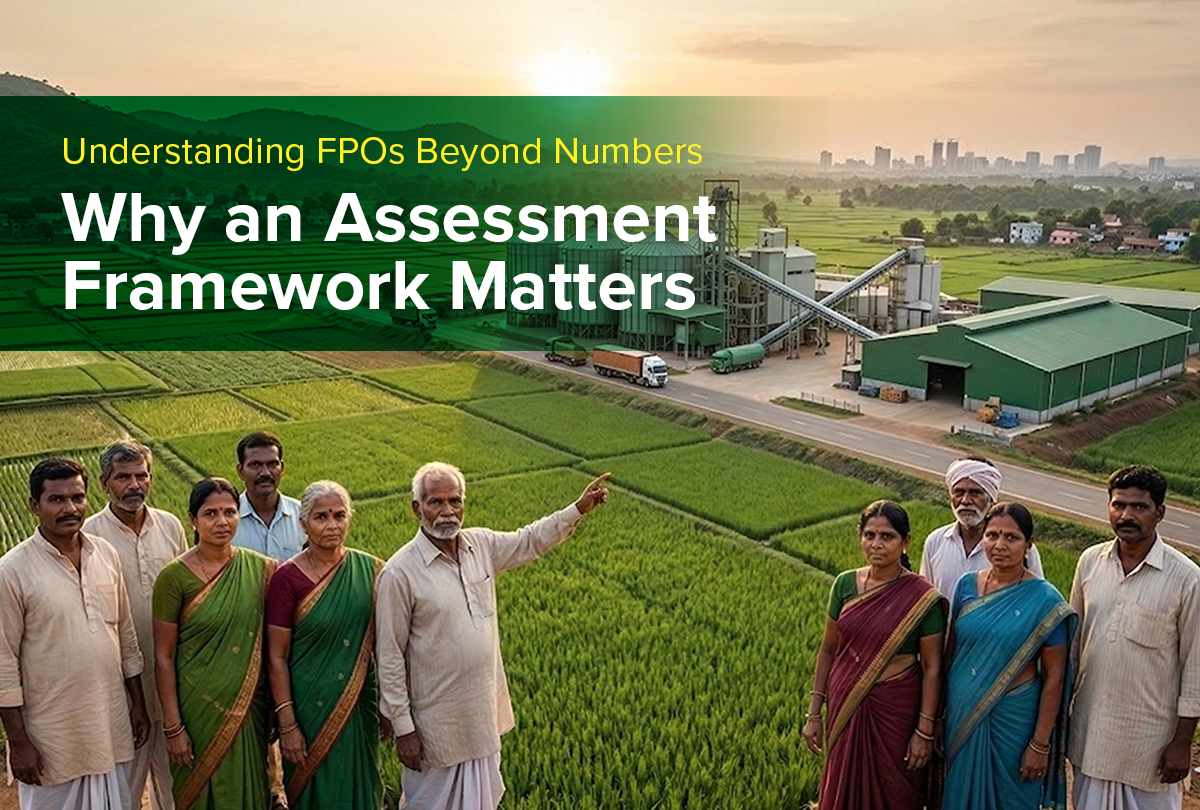
The Rise of FPOs, and the Gap Beneath
Farmer Producer Organizations (FPOs) have emerged as a powerful model to strengthen smallholder farmers by enabling collective action, better market access, and improved price realization.
With increasing policy support and capital flowing into the sector, FPOs are no longer seen as just community-based institutions; they are evolving into business entities with the potential to scale.
Yet, one fundamental challenge has persisted:
There has never been a clear, standardized way to understand and evaluate an FPO.
While the ecosystem has grown rapidly, the ability to assess FPOs in a structured, objective manner has not kept pace.
Why the Need for an FPO Assessment Framework
For years, stakeholders across the ecosystem, lenders, investors, and development organizations, have struggled with a common issue:
- FPOs could not be assessed like traditional companies
- Financial metrics alone did not capture their full potential
- Decision-making lacked a consistent and comparable framework
This created a disconnect.
High-potential FPOs often remained under-supported, while financial institutions faced challenges in evaluating risk and extending credit confidently.
At the same time, with increasing funding being directed towards the sector, the need for accountability, benchmarking, and performance evaluation became critical.
What the ecosystem needed was clear:
A framework that could objectively assess FPOs across multiple dimensions, balancing enterprise thinking with their unique nature.
Samunnati’s Approach: Building a Common Language
At Samunnati, years of working closely with FPOs revealed that the challenge was not just about access to finance, but about how FPOs are understood.
To address this, Samunnati engaged with CRISIL to co-create a comprehensive FPO Assessment Framework.
The objective was simple yet ambitious:
- To bring structure and standardization to FPO evaluation
- To create a common language across stakeholders
- To enable FPOs to be seen as credible and assessable enterprises
What is the FPO Assessment Framework?
The FPO Assessment Framework is a structured, evidence-based tool that provides a holistic view of an FPO’s performance.
It goes beyond surface-level evaluation to:
- Highlight key strengths
- Identify critical risks
- Provide insights into growth potential
This allows stakeholders to move from perception-based understanding to data-driven decision-making.
A Holistic View: The Pillars of Assessment The framework evaluates FPOs across four core pillars:
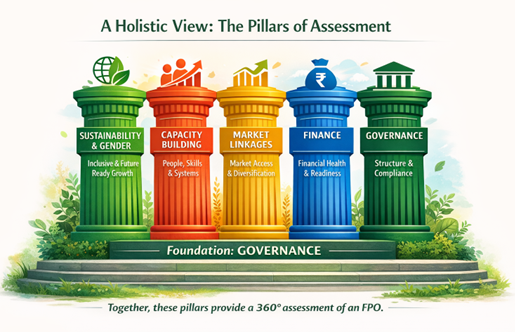
Beyond Evaluation: A 360-Degree Assessment
What makes this framework unique is its depth and adaptability.
- It captures over 200 data points per FPO
- Combines quantitative and qualitative analysis
- Adapts to the maturity level of the FPO
This ensures that an emerging FPO and a mature FPO are both assessed fairly, with context and nuance.
From Assessment to Action: The Role of Grading
A key strength of the FPO Assessment Framework is its ability to translate complex data into a clear and standardized grading system. Based on multiple parameters across governance, finance, market linkages, and capacity, each FPO is assessed and categorized into defined performance bands.
This grading provides:
- A snapshot of the FPO’s current maturity and risk profile
- Clear visibility into strengths and areas of improvement
- A benchmark for year-on-year progress tracking
Beyond just scoring, the grading framework also incorporates indicators such as credit risk, operational stage (nascent to mature), and sustainability metrics, enabling stakeholders to make more informed and confident decisions.
Built with Ecosystem Insights
The development of the framework was rooted in extensive engagement with the ecosystem.
It involved:
- Internal teams across Samunnati
- Financial institutions and lenders
- Development organizations and consortiums
- Multiple FPOs across geographies
The framework was also tested across 10 states through pilot studies, ensuring its applicability across diverse contexts.
This collaborative approach helped create a framework that is both practical and scalable.
What This Enables
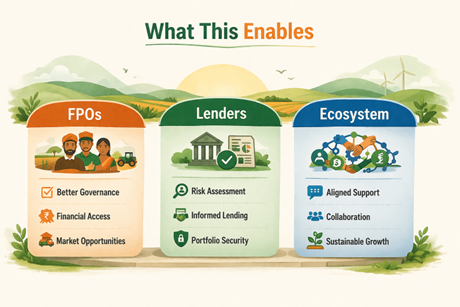
The introduction of a structured assessment framework marks a significant shift in how FPOs are perceived.
From informal collectives to structured enterprises
From potential-driven to performance-driven
From fragmented understanding to standardized evaluation
This shift is essential to solve the next phase of growth for the FPO ecosystem.
The Way Forward
As the ecosystem continues to expand, the need for credible, transparent, and scalable assessment mechanisms will only grow stronger.
The FPO Assessment Framework is a step in that direction.
It not only enables better evaluation but also supports FPOs in their journey towards becoming resilient, sustainable, and growth-oriented institutions.
Because when FPOs are understood better, they are supported better.
And when they are supported better, they create a lasting impact where it matters the most, on the ground.